
Keywords
Body posture
Classroom teaching
Free time
Obesity
How to Cite
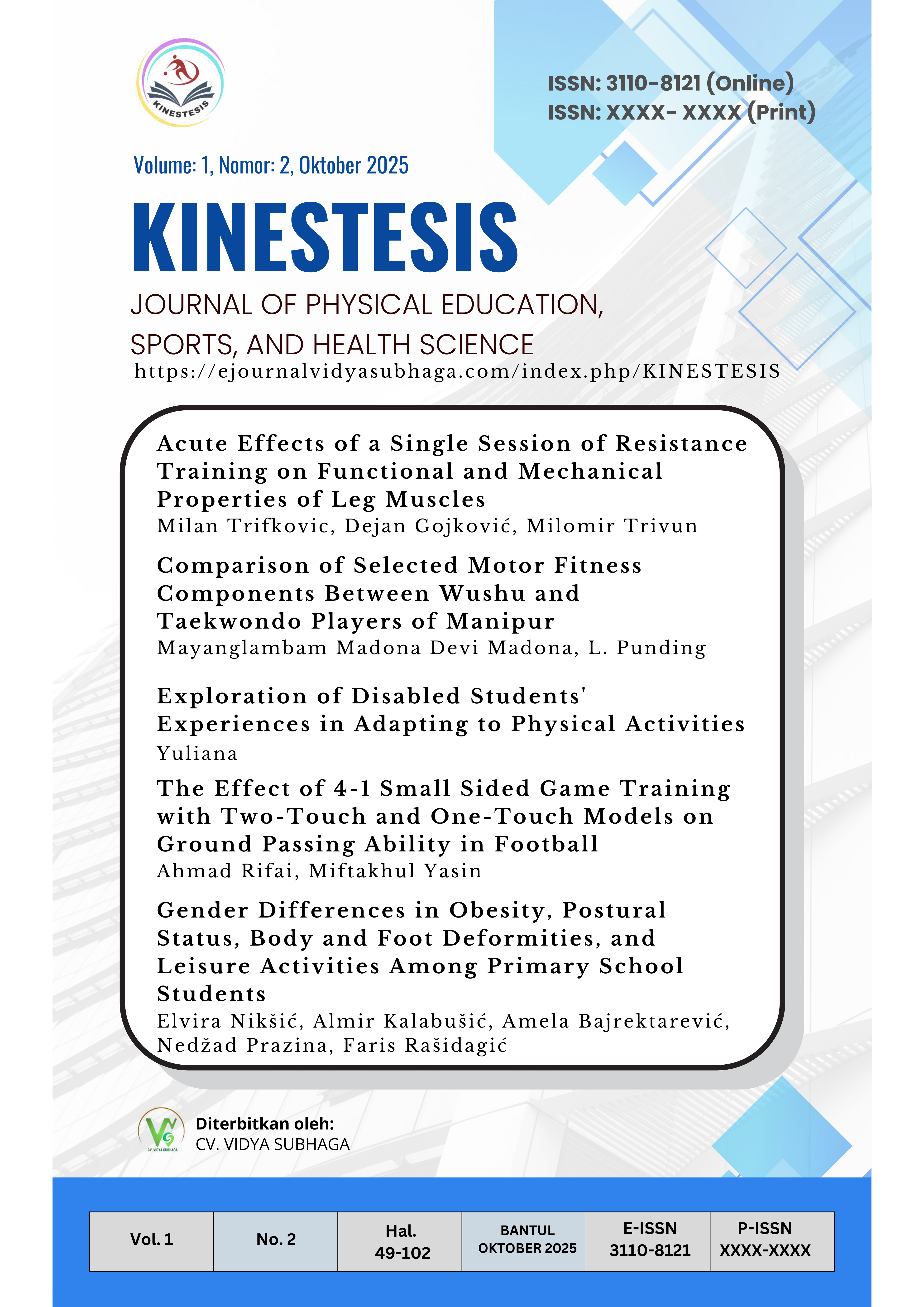
Abstract
Background: Correct body posture should be at the very top, because it is an essential prerequisite for good health, normal growth and development, and good looks of every student. Inadequate spending of free time leads to the appearance of obesity, improper posture, and the appearance of physical deformities.
Aims: This research aims to determine the prevalence of obesity, improper body posture, body deformities, and the way of spending free time among primary school students according to gender.
Methods: The research was carried out on a sample of a total of N=1,850 primary school students, of which there were N=989 (53%) male respondents and N=861 (47%) female respondents. Analyzing the results of morphological characteristics, it was determined that boys have a higher body mass index (BMI) than girls.
Result: The obtained results are statistically significant at the level of less than 1% (p<0.01), and the results were in favor of girls. Obesity and excessive nutrition are more prevalent in boys than in girls. By measuring the lateral curve of the spinal column, the following results were obtained: 67.24% of boys have improper posture, and 37.52% of girls.
Conclusion: Classroom data show children spend substantial free time on electronic devices, especially boys gaming on computers and tablets. Girls more often engage in sports, television viewing, reading, and mobile communication. Preventive action is needed through regular student monitoring, testing, and measurement to track developmental changes and promote healthier lifestyle patterns in school contexts.
References
Abazović, E., Hasanbegović, S., Kovačević, E., Okanović, I., Kazazović, E., Ademaj, Z., Lakota, R., & Mekić, A. (2016). Obesity among elementary school children in Sarajevo Canton: Presentation of the research results conducted on 33,200 children. Ministry of Education, Science and Youth of Sarajevo Canton; Ministry of Health of Sarajevo Canton.
Aščić, F., Branimir, M., Begović, D., & Pireva, F. (2015). Differences in spinal deformity - scoliosis in male and female students of the triad of a nine-year elementary school. In 5th International Conference on Sports Science and Health (Vol. 28, pp. 272–278).
Bajrić, O., Lolić, S., Perić, R., & Kovačević, D. (2012). Frequency of deformities on the backbone of pupils. Sportske nauke i zdravlje, 2(2), 175–181. https://doi.org/10.7251/SSH1202175B
Bajrić, O. (2018). Obesity and postural status of children and adolescents. In O. Bajrić & Đ. Ničin (Eds.), Eighth International Conference “Sports Sciences and Health” (pp. 17–32). Pan-European University Apeiron.
Baranowski, T., & Taveras, E. M. (2018). Childhood obesity prevention: Changing the focus. Childhood Obesity, 14(1), 1–3. https://doi.org/10.1089/chi.2017.0303
Beganović, E., & Bešović, M. (2012). Body posture analysis in younger school-age students in the city of Sarajevo. Sportski logos, 10(19), 25–33.
Bešović, M. (2011). Kinesiological methodology in education (II), Methodology of kinesiological education of preschool and younger school-age children. Bosnian Word.
Bjeković, G., Arnaut, Đ., & Gerdijan, N. (2011). Foot deformities in preschool children in the kindergarten "Nova radost" - East Sarajevo. Sport Mont, 31–33, 48–52.
Bogdanović, Z., & Marković, Ž. (2010). The presence of foot deformities depends on gender. Journal of the Anthropological Society of Serbia, 45, 397–402.
Bogdanović, Z., & Milenković, S. (2008). Presence of irregular posture of younger school age depends on the way of sitting. Glasnik Antropološkog društva Jugoslavije, 43, 365–370.
Čibo, S. (2001). Orthopedics. Faculty of Medicine, University of Sarajevo.
Čolakhodžić, E., Vuk, N., Habul, Ć., Vujica, S., & Tanović, S. (2017). Obesity and postural status of children of primary school age in the City of Mostar. Džemal Bijedić University in Mostar, Faculty of Teaching.
Đorđević, S., Jorgić, B., Milenković, S., Stanković, R., & Stanković, M. (2020). The incidence of spinal postural disorders in first-grade elementary school students. Facta Universitatis, Series: Physical Education and Sport, 18(3), 381–390. https://doi.org/10.22190/FUPES200614035D
Đulić, I. (2001). Singing games and their application in the implementation of elementary games [Master’s thesis, Faculty of Sport and Physical Education, University of Sarajevo].
Ilišin, V. (2001). Leisure time. In V. Ilišin (Ed.), Children and the media: The role of media in children’s everyday lives (pp. 91–118). State Institute for the Protection of Family, Motherhood and Youth.
Jorgić, B., Milenković, M., Ždrele, S., Milenković, S., Stanković, R., & Bubanj, S. (2015). Spinal cord posture in the sagittal plane among young schoolchildren residing in the area of Knjaževac. Facta Universitatis, Series Physical Education and Sport, 13(2), 311–318.
Krsmanović, T. (2007). Posturalni poremećaji i kako ih sprečiti. Glasnik Antropološkog društva Jugoslavije, 42, 369–375.
Kuczmarski, R., Kuczmarski, M. F., & Roche, A. F. (2002). 2000 CDC growth charts: Background for clinical application. Topics in Clinical Nutrition, 17(2), 15–26. https://doi.org/10.1097/00008486-200203000-00006
Kumar, M. D., & Kelly, A. S. (2017). Review of childhood obesity: From epidemiology, etiology, and comorbidities to clinical assessment and treatment. Mayo Clinic Proceedings, 92(2), 251–265. https://doi.org/10.1016/j.mayocp.2016.09.017
Lafond, D., Descarreaux, M., Normand, M. C., & Harrison, D. E. (2007). Postural development in school children: A cross-sectional study. Chiropractic & Osteopathy, 15(1), Article 1. https://doi.org/10.1186/1746-1340-15-1
Marfell-Jones, M., Olds, T., Stew, A., & Carter, L. (2006). International standards for anthropometric assessment. The International Society for the Advancement of Kinanthropometry. https://doi.org/10.4324/9780203970157
Medojević, S., & Jakšić, D. (2007). Differences in postural disorders between girls and boys aged 7–15 in the territory of Vojvodina. In G. Bala (Ed.), Anthropological status and physical activity of children, youth and adults (pp. 49–54). Faculty of Sports and Physical Education.
Mišigoj-Duraković, M., Sorić, M., & Duraković, Z. (2014). Anthropometry in the assessment of cardio-metabolic risk. Archives of Industrial Hygiene and Toxicology, 65(1), 19–26. https://doi.org/10.2478/10004-1254-65-2014-2381
Nikšić, E., Mahmutović, I., & Rašidagić, F. (2015). Postural spine disorder with students of classroom teaching with regard to the gender. In 5th International Conference on Sports Science and Health (Vol. 28, pp. 100–111).
Nikšić, E. (2016). Frequency of foot deformities in primary school students by gender. In 1st International, Sport, Science, Education and Development Conference (InSSED) (pp. 53–63). Vlašić, Bosnia and Herzegovina.
Nikšić, E., Rašidagić, F., & Beganović, E. (2019a). Examination of the differences in the representation of deformities of individual body parts in initial and final measuring. Sport Science, 12(1), 36–45.
Nikšić, E., Rašidagić, F., Beganović, E., & Németh, Z. (2019b). Analysis of feet status of students classroom teaching in urban and rural areas of Sarajevo. Sport Science, 12(1), 27–35.
Nikšić, E., Rašidagić, F., & Beganović, E. (2019c). Postural disorders in primary school students and their prevention and correction. Faculty of Education, University of Sarajevo.
Nikšić, E., & Beganović, E. (2020). Spinal deformities with students in classroom teaching in urban and rural areas. In IntechOpen. https://doi.org/10.5772/intechopen.87977
Nikšić, E., Beganović, E., & Gojković, D. (2020). The frequency of spinal deformities of students in lower elementary school grades with regard to gender. International Journal of Science Academic Research, 1(9), 679–686.
Nikšić, E., Joksimović, M., Beganović, E., & Gardašević, N. (2021). Differences in the degree of nutrition and body composition of boys and girls of pubertal age. Pedagogy of Physical Culture and Sports, 25(1), 4–9. https://doi.org/10.15561/26649837.2021.0101
Nikšić, E. (2023). Second International Scientific and Professional Conference "Window into the World of Education, Science and Youth", Sarajevo, 19–20 May 2023.
Nikšić, E. (2024). Differences in motor abilities between boys and girls IV. grade of elementary school. Anthropologie (Brno), 62(3), 219–230.
Paić, A. (2019). The influence of parents on the state of nutrition and eating, and living habits of children aged 7 years [Specialist paper, Josip Juraj Strossmayer University of Osijek, Faculty of Food Technology].
Protić-Gava, B., & Šćepanović, T. (2014). Basics of kinesitherapy and applied corrective gymnastics. Faculty of Sports and Physical Education, University of Novi Sad.
Protić-Gava, B. (2015). Good posture in childhood – Security for the future of a better quality of life. In 5th International Conference “Sports Sciences and Health” (pp. 9–18). Banja Luka.
Puska, P., Nishida, C., & Porter, D. (2003). Obesity and overweight. World Health Organization, 1–2.
Rašidagić, F., Nurković, N., Imamović, T. D., Hadžibulić, N. H., Nikšić, E., & Kapo, A. (2020). Differences between morphological characteristics and motoric capabilities of physically active and inactive female students. Pedagogy of Physical Culture and Sports, 24(1), 30–35. https://doi.org/10.15561/26649837.2020.0105
Romanov, R., Stupar, D., Međedović, B., & Brkin, D. (2014). Postural status of preschool children in Novi Sad. TIMS. Acta, 8, 129–135. https://doi.org/10.5937/timsact8-5000
Rosić, V. (2005). Free time – Free activities. Naklada Žagar.
Taljić, I., & Nikšić, E. (2016). Impact of food habits on BMI category of adolescent boys. In 18th Danube-Kris-Mures-Tisza (DKMT) Euroregion Conference on Environment and Health (p. 26). University of Novi Sad.
Taljić, I. (2019). Nutrition of school children and adolescents. University of Sarajevo, Center for Interdisciplinary Studies.
Vukićević, V., Pajić, N., Čokorilo, D., Lukić, N., Miličković, V., & Bjelica, M. (2018a). Postural status of young school-age children from urban and rural areas. Bulletin of the Anthropological Society of Serbia, 53, 71–77. https://doi.org/10.13140/RG.2.2.36476.08327
Vukićević, V., Čokorilo, D., Lukić, N., Miličković, V., & Bjelica, M. (2018b). The presence of postural disorders in children of the younger school age. Timok Medical Gazette, 43(3), 100–107.
Živković, M., Bogdanović, Z., Midić, D., Herodek, K., & Stojanović, S. (2011). Postularni poremećaji školske dece. Sport Mont, 28–30, 358–367.

This work is licensed under a Creative Commons Attribution 4.0 International License.
Copyright (c) 2025 KINESTESIS: Journal of Physical Education, Sports, and Health Science